How to: Off-Grid Propane Powered Refrigerators
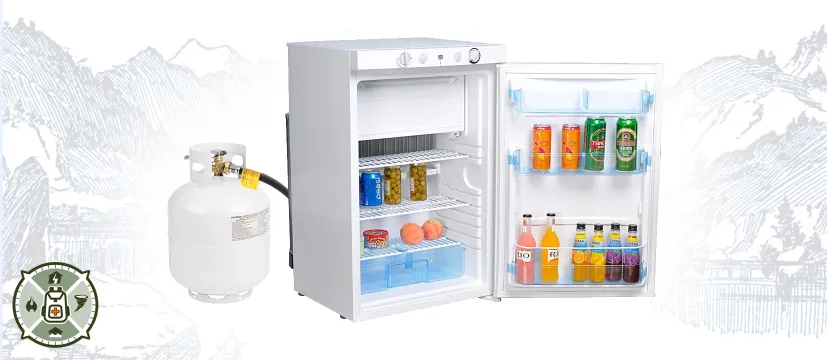
Many people don't realize this, but you can easily and affordably run refrigerators off of a tank of propane, as long as you have the right kind of fridge.
Propane powered fridges are not your standard modern compressor driven 110v refrigerators, they use a different type of cooling system (absorption) designed and in use for nearly 100 years.
So if power outages are a concern where you live, or you want to bring a fridge along for a long term camp out, then propane is the way to go.
Propane Fridge Advantages

There are a number of reasons you might want to get your hands on a propane powered fridge:
- Excellent for off-grid use: campsite, cabins, RV's, etc
- Backup for power outages, no need to procure ice every few days or deal with coolers, make your own
- Easy to switch between propane / 110v (home power) / 12 volt (solar / battery) power sources
- Some models are small enough to be considered portable
- Great excuse to have a backup fridge in the garage (aka a "beer library")
Some things to consider that may affect your decision:
- Pricier than their electric only counterparts, until you get into the larger sized models, then the pricing is about the same
- When in propane mode, there is a pilot light which is running all the time on the backside of the unit
- It gets hot in the back, it uses heat to generate the cold, you'll need ventilation / space in the back
How they Work
The propane refrigerator we have is a single pressure absorption refrigerator. It doesn't use any motors or fans, but instead relies on the chemistry of liquids and physics to cool food items.
Along the back of the fridge is a closed system of tanks, pipes and radiators which are filled with ammonia, hydrogen gas, and water.

The ammonia is heated by the pilot light connected to the propane tank, and then it evaporates, and when it condenses, it gets very cold. Using this principle, the water and hydrogen (along with a heat source) facilitate the ammonia evaporating in such a way as to rapidly cool a specific area: the inside of your fridge.
It's a slightly complex process, but you can get a good idea how it all works from the diagram and video below.

Now...if only someone could make this type of system work for off-grid air conditioning we'd be set!
Where to Get One

SMETA Fridge / Freezer 12V/110V/Propane - 3.5 Cu.Ft
Typical Price: $989
Propane electric absorption refrigerator with freezer. Approximate gas consumption per day: 0.6 lb. Runs on grid electric, 12 volt systems (solar/batteries) and propane.
Large enough to feed a family of 4 for a week, small enough to move if required.
Product dimensions (W*D*H): 20.6*23.2*32.2inch, 3.0 cu ft refrigerator and 0.4 cu ft freezer. Weight: 70 lbs.

SMETA Fridge / Freezer 12V/110V/Propane - 3.5 Cu.Ft
Typical Price: $1,599
Propane electric absorption refrigerator with freezer. Approximate gas consumption per day: 1.6 lb. Runs on grid electric, 12 volt systems (solar/batteries) and propane.
This is nearly a full sized refrigerator, would make a great backup / garage fridge.
Product dimensions (W*D*H): 23.6 x 29.1 x 64.2 inches, 7.3 cu ft refrigerator and 2.1 cu ft freezer. Weight: 168 lbs.
+ Add to bag~$1,670 · 154.3 lb

Got a question about your bag?
Ask it in the Bug Out Bag Builder group on Facebook. Members share their builds, compare gear and help each other out.
Up Next