Long-Term Food Storage: How to Store Food for 20+ Years
A few weeks of canned food covers most emergencies. Long-term food storage is for the bigger ones: a job loss, a long supply disruption, or simply wanting a pantry that doesn’t depend on the next truck. Done right, the basics like white rice and dried beans keep for decades. Here’s how to store food for 20 years or more, what to buy, and how to avoid the mistakes that waste money.
Quick answer: how do you store food long term?
- Store the right foods: white rice, dried beans, wheat, oats, sugar, salt, dried milk and freeze-dried meals. The list
- Remove oxygen, moisture and light: seal dry foods in Mylar bags or #10 cans with oxygen absorbers. How to pack it
- Keep it cool: 40–70°F, dry and dark. Heat is the biggest shelf-life killer. Where to store it
- Rotate and eat it: store what you already eat, and label everything with the date.
Short, Medium and Long Term
Ready.gov recommends at least a several-day supply of non-perishable food that doesn’t need refrigeration, cooking, water or special preparation (Ready.gov: Food). Think of your food storage in three layers:
- Grab-and-go (3 days): lightweight food in your bag. See our 72-hour food guide.
- Pantry (6 to 12 months): the canned and boxed food you eat and rotate. See medium-term food storage.
- Long term (10 to 30 years): sealed staples and freeze-dried food you set aside and mostly forget. That’s this guide.
The Best Foods for Long-Term Storage
The foods that last longest are dry, low in fat and sealed away from oxygen.
- White rice. Utah State University Extension says properly sealed polished white rice stores well for 25 to 30 years, and up to 10 years at a constant 70°F with oxygen absorbers (USU Extension: Storing White Rice). Brown rice has oils that go rancid much sooner.
- Dried beans. Best stored without oxygen or light, which cause rancidity and fading (USU Extension: Food Storage Packaging). Older beans take longer to cook, so a pressure cooker helps.
- Hard wheat (and a hand grain mill to use it).
- Rolled oats, repackaged. Retail canisters aren’t made for long-term storage.
- Sugar, honey and salt. Stored dry, they keep more or less indefinitely.
- Nonfat dried milk, sealed away from moisture, light and oxygen.
- Freeze-dried meals and #10 cans. Easy to cook with just hot water, and a good morale boost. Mountain House backs its food with a 30-Year Taste Guarantee, as long as it’s stored unopened and kept from long stretches above 75°F (Mountain House).
Foods that don’t store well long term: brown rice, whole-wheat flour, nuts, cooking oils and anything else high in fat. Fats go rancid, and plastic containers let oxygen in within a year or two (USU Extension). Rotate those through your pantry instead.
How to Pack Food for the Long Haul
Oxygen, moisture, light, heat and pests are what ruin stored food. Good packaging blocks all of them.
Choose a Container
- #10 cans: the best oxygen barrier there is, and rodent-proof. A #10 can holds about 5.7 pounds of rice (USU Extension). Easiest to buy already packed.
- Mylar bags: the foil layer is an excellent barrier to oxygen and moisture. Rodents can chew through them, so put the bags inside a bucket.
- Food-grade buckets: a 5-gallon bucket with a gasket lid or a screw-on gamma lid, lined with Mylar bags. Smaller bags inside the bucket make rotation easier.
- PETE bottles (like clean 2-liter soda bottles) with oxygen absorbers work for smaller amounts. Check that the cap seals by dunking a sealed empty bottle in water.
Step by Step: Mylar and Buckets
- Start with dry food. Only pack foods that are dry and low in fat. Let anything you dried yourself cool completely; sealing warm food causes condensation and mold.
- Kill bugs first if needed. USU recommends freezing rice for three days to kill insects and larvae, then letting it come back to room temperature before sealing.
- Fill the Mylar bag inside the bucket, leaving a few inches at the top.
- Add oxygen absorbers right before sealing. Work quickly; they start working as soon as the package is opened. Follow the absorber maker’s chart for how many per bag size.
- Press out the air and heat-seal the bag with a hair-straightening iron or a clothes iron on a board.
- Label it: contents, date packed and amount.
- Lid the bucket and store it off the floor.
ShopMylar + O2 Absorbers ShopBuckets + Gamma Lids
Buying It Ready-Made
If you’d rather not pack your own, freeze-dried meals in pouches and #10 cans are the easiest way to build a long-term supply. Pouches are lighter and pack into a bug out bag; cans are cheaper per serving and tougher in storage.
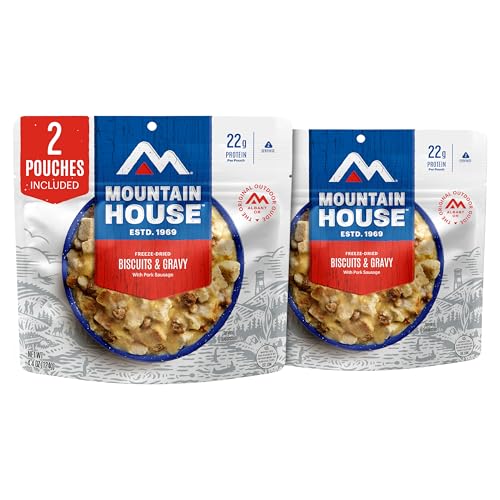
Mountain House Freeze-Dried Breakfast
Typical Price: $22
Just add hot water. Freeze-dried meals are the easiest way to add variety and morale to a long-term supply, and they double as bug out bag food.
See our Mountain House 3-Day kit review and Valley Food Storage 175-serving review for two ways to buy in bulk.
A word on “25-year buckets”: read the label before you buy. Many count small servings and come in well under 2,000 calories a day, the figure the FDA uses as a general guide for nutrition advice (FDA). Compare total calories, not servings. Our prepper nutrition guide walks through the math.
Where to Store It
- Cool: the best temperature for grains is 40°F or below, and USU’s numbers show rice lasts far longer in a cool space than at 70°F (USU Extension). A basement or an interior closet beats a hot garage or attic every time.
- Dry and dark: keep buckets off concrete floors on a pallet or shelf, away from water heaters and windows.
- Spread out: keep some in more than one place in case one spot floods or you have to leave.
- Pest-proof: buckets and cans, not bags on a shelf.
How Much Should You Store?
Start with a goal you can reach: one month for everyone in the house, then three, then six. Plan by calories and by what your family will actually eat. A simple starter month for one adult might be white rice, dried beans, oats, sugar, salt, cooking oil you rotate through the pantry, a case of freeze-dried meals, and a multivitamin.
Don’t forget the rest of the system:
- Water to cook it. Rice and beans need water. See our water storage and filter guide.
- A way to cook without power: a camp stove and fuel, stored and used outdoors.
- A manual can opener and utensils (Ready.gov).
- Special diets: plan for allergies, babies and anyone on a medical diet.
Long-Term Food Storage FAQ
What food lasts the longest in storage?
White rice, dried beans, hard wheat, sugar, honey and salt, sealed away from oxygen and moisture. Properly packed white rice can store 25 to 30 years in a cool place.
Do I need oxygen absorbers?
For rice, beans, dried milk and most dry foods, yes. They protect quality and keep insects from developing. Don’t use them with sugar or salt, which turn into a hard brick.
Can I store food in the garage?
Only if it stays cool. Summer heat in a garage can cut shelf life dramatically. A closet or basement is better.
Is freeze-dried food worth it?
Yes, as part of the plan. It’s easy to cook with just hot water and lasts decades, but it costs more per calorie than rice and beans you pack yourself.

Got a question about your bag?
Ask it in the Bug Out Bag Builder group on Facebook. Members share their builds, compare gear and help each other out.